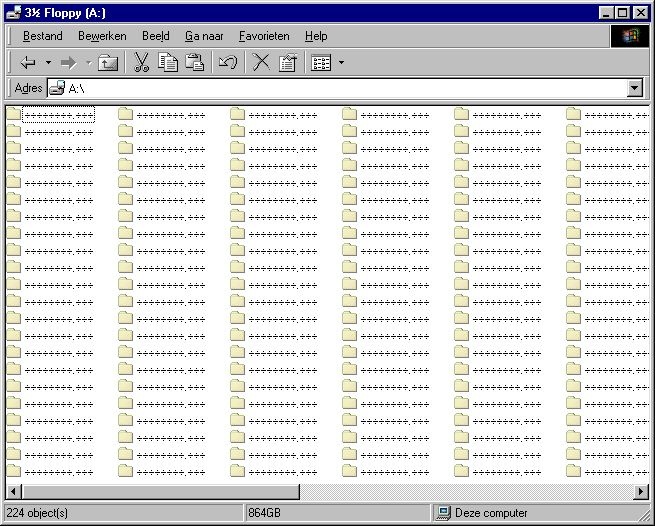
ik zie geen patch alleen maar een workaround. Daar ben ik op zich al heel blij mee maar deze bug is er nu al bijna een jaar.
WORKAROUND
Warning This article contains instructions to add a DWORD value in the registry. When you add the DWORD value, it partially disables the Critical Update 813489 for Internet Explorer. After you add the DWORD value, you can customized Outlook Today, but you will be vulnerable to an information-disclosure vulnerability that is related to the way that Internet Explorer handles encoded characters in a Web address (a Uniform Resource Locator [URL]). For more information about this vulnerability, see the "More Information" section of this article. Microsoft recommends that after you have customized Outlook Today, you remove the DWORD value, or you disable the DWORD value by setting it to 0 to help protect your computer from this vulnerability.
Ik hoop wel dat de reden voor het lange wachten betreft dat het een complex probleem is. Want het treft wel de mensen met een Imap server het meest.
Prima voldoet? Ik heb hier het
Linux Administrator Handbook liggen: In het hoofdstuk over DNS staat ook een stukje over Windows 2000 DNS. Ik wil het jullie niet onthouden:
Microsoft bad, Linux good
Windows 2000 uses SRV resource records to discover everything: name servers, printers, filesystems and so forth. They have followd the IETF specs in their implementation of SRV records, but the way that they insert the records into DNS by using a secure dynamic update is nonstandard. Microsoft uses a variation of transaction signatures called GSS-TSIG that is also based on a shared secret. The shared secret is obtained through kerberos from the kerberos KDC (Key Distribution Center). At the moment, Microsofts's implementation uses the vendor extensions field and therefore is not compatible with the open source version of Kerberos 5 (Hmm... Embrace, extend, exterminate)
If you want to run Win2k and use SRV records, you'll have to nuke your existing Kerberos realm and run a Win2k Kerberos server on your netwroks. Form some sites with a rich Kerberos infrastructure, this problem is a showstopper. Microsoft seems to be using open protocols just enough to sneak past companies purchasing checklist, but nog enough to allow anyone else to interoperate and sell into their market. Hopefully microsoft will document their extensions without the currently required nondisclosure agreement so that ISC can make its TSIG and Microsoft's GSS-TSIG interoperate.
About a week after Win2K was released, the query load on the DNS root server increased significantly. A bit of digging revealed that misconfigured Win2k boxed were trying to dynamically update the root or top-level zones. The number of UDP queries to the A root server more than doubled as a result. To make matters worse, whan their update requests were refused, the Win2k boxes asked for a KEY record to try and authenticated update. This also failed, so they tried on final time by opening a TCP connection to attempt an authenticated update. A root server does not have time for the zillions of TCP connection requests that resulted. As go to press, the situation is somewhat better now but still not completly resolved, with root server operators pointing fingers at Microsoft and Microsoft saying "No, no, not us!"
At this point, it's best to avoid Microsfts's DNS implementation as much as possible. You will problably want to point your Win2K boxes at a
Linux name server to gain full DNS functionality without the shotgun blasts of unnecessary traffice generated by Microsofts's "creativity".
Microsoft server raise a ruckus when thy query a zone whose servers are all lame. If yhour site delegates to server appear to be lame, it's good practice to at least install an empty zone file that substitutes for the missing servers. This measure will prevent Microsoft server that query for the lame name from becomming confused an pummeling the root and gTLD servers.
Ik vindt de software die Microsoft de laatst jaren (van af 2000) uitbrengt van behoorlijke kwaliteit. Daarvoor vondt ik het altijd bagger. Maar mijn grootste klacht richting Microsoft is dat ze altijd zo hun best doen om hun software niet met die van concurrenten te laten samenwerken.
Ik krijg van mensen vaak te horen dat ICT ervoor heeft gezorgd dat mensen afhankelijker zijn geworden van een systeembeheerder bij het doen van hun werk. Ik kan dit alleen maar bevestigen. Het niet goed samenwerken van software met elkaar verergerd dit alleen nog maar. Onder
linux kan ik heel veel bestandsystemen benaderen.
Linux ntfs is op dit moment alleen nog maar betrouwbaar te benaderen in alleen lezen modus. Dit alleen omdat Microsoft de specificaties niet wil geven.
Ander voorbeeld: Het is op een Microsoft Pocket PC alleen mogelijk om de standaard Outlook non-mail folders te synchroniseren. Wil je een gedeelde Agenda syncroniseren dan heb je Active Exchange nodig, dus ook een exchange server. Wij delen echter non-mail folders met de Bynari plugin. Microsoft Active sync doet net of deze gedeelde mappen niet bestaan en laat alleen de standaard Outlook mappen zien. Ik heb gebruikers wel een geprobeerd uit te leggen waarom dit zo is, maar mensen snappen dat gewoon werkelijk niet.
Ik heb hier het boekje Windows 2000 commando's kort en krachtig liggen. Er kan veel meer met de commando regel in Windows 2000 als men denkt. Maar het is gewoon niet de methode waar Windows voor is geoptimaliseerd.
[
Voor 3% gewijzigd door
Verwijderd op 29-11-2003 15:03
. Reden: toevoeging ]
mooi gesproken!!

:strip_exif()/u/19799/lotr01_6060.gif?f=community)
/u/43807/ZwartGat.png?f=community)


:strip_icc():strip_exif()/u/40949/polarwolf.jpg?f=community)
:strip_exif()/u/70496/glowmouse2.gif?f=community)
 ), vindt de nieuwe UI van Windows fantastisch.

:strip_exif()/u/851/pb_logo.gif?f=community)

:strip_exif()/u/36176/44.gif?f=community)
/u/38159/DirkJan.png?f=community)
:strip_icc():strip_exif()/u/50076/dosto_60.jpg?f=community)


/u/23391/avatar.png?f=community)


:strip_icc():strip_exif()/u/4167/bacall8.jpg?f=community)
:strip_icc():strip_exif()/u/29534/moto-icon.jpg?f=community)
 . Waar
 /u/1491/crop6142e563aff0e_cropped.png?f=community)
/u/35667/SP_Erik.png?f=community)
:strip_exif()/u/29084/got_vorloxlogo.gif?f=community)
 Dit topic is gesloten.